Build By Adding Not By Cranking
The most common instinct when a climax isn’t working is to make it louder. It doesn’t help. The passage was already loud. The fff wasn’t the problem. The problem was that the texture at fff sounded exactly like the texture at ff, just with more pressure. Adding volume without adding structure is the orchestrational equivalent of yelling the same sentence twice.
There’s a better principle, and it’s one I keep finding at the core of every climax that actually works, from Grieg to Williams to the cues I work on every week. I’ve started calling it build by adding, not by cranking.
What Grieg Teaches in 29 Bars
The opening of Morning Mood is one of the cleanest orchestration lessons in the standard repertoire. In 29 bars, Grieg takes a single melody from a solo flute at p to a full string tutti at f—and he does it almost entirely through orchestration, not through dynamics.
The flute plays the melody alone. Then the oboe takes it with a dynamic bump and a register overlap against the strings—but it works because the colour is different, not because the volume is higher. Then the strings arrive, and Grieg plays a trick: instead of writing the same melody louder, he combines the melody with its own accompaniment from earlier bars. Two textures that existed separately are now stacked. 1 + 1 = 3.
This is the heart of the additive principle: you don’t build a climax by turning up what you’ve got. You build it by adding a new element—a new instrument, a new register, a new doubling—that interacts with what’s already there to produce something larger than either part alone.
The Additive Sequence
In practice, the additive build follows a rough sequence. It’s not a rule—it’s a gravity. Composers and orchestrators tend to add tools in this order:
Primary line → octave reinforcement → thickening → accent.
A melody starts on one instrument. Then it gets doubled an octave above or below—now it has mass without losing clarity, because the ear reads a clean octave as one voice. Then interval-locked thickening fills in: thirds, sixths, close voicing. Each step changes the weight of the line without changing its identity.
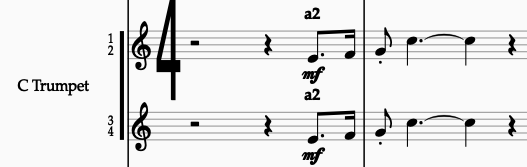
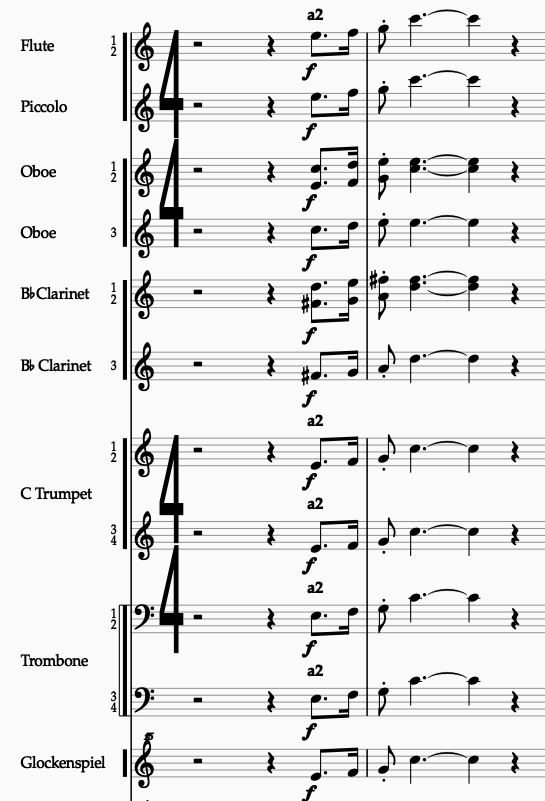
Williams does this in virtually every main-title cue. The Raiders March states the melody first on trumpets in unison—nothing else. The second time the theme enters, the trombones double in octaves, flute and piccolo add octaves above, second oboe and second clarinet thicken with a third or sixth below the melody, and a glockenspiel doubles at the top. Same melody, same tempo, same energy—but the texture has grown along exactly these axes: weight (trombone octave below), width (the thirds and sixths), definition (the glockenspiel’s transient attack above). The growth you hear is structural before it’s dynamic.
Why It Works
When you add an octave doubling, the ear doesn’t hear “two instruments playing.” It hears one voice that suddenly has more weight—more of the harmonic series is being excited. A flute on C5 and a clarinet on C4 don’t sound like two separate things; they sound like one thing that’s richer.
When you add a third or sixth, the voice gets wider—it occupies more vertical space without breaking into separate lines. This is the principle behind every brass chorale, every string pad: the melody is one line, but the voicing around it makes it feel architectural.
When you add a rhythmic accent or a transient attack (harp, piano, pizzicato, percussion), the line gets definition—the front of the note sharpens even if the sustain doesn’t change. This is why timpani entering at a climax works: not because it’s louder, but because the attack profile of the whole orchestra changes.
Three axes of addition. Weight (octave). Width (thickening). Definition (accent). Build along these axes and the climax grows by structure. Build only along the dynamic axis and the climax just gets louder.
The Counter-Move: Build by Removing
The inverse is equally powerful. Mahler’s technique of creating a diminuendo by removing instruments rather than marking pp is the same principle in reverse. If a timpani drops out at the moment the strings swell, the listener hears the swell and an unexplained loss of foundation—two emotional signals from one event.
Grieg does this at the climax of Morning Mood: the timpani drops out just before the section truly arrives, trusting the orchestra to carry the momentum. It works because the ear notices the absence, and the absence gives the arrival room to land.
The teaching point is the same either way: changes in structure are more powerful than changes in dynamics. Add a player, remove a player, double a line, thin a voicing—these are architectural moves. Hairpins and fff are paint.
The Earlier Problem
There’s a third possibility worth considering. If you’re at ff and the only move you can think of is fff, the problem might not be at the climax at all. It might be earlier.
Maybe you switched gears too soon. Maybe the build-up arrived at full orchestration four bars before the real peak, and now the peak has nothing left to add. The texture is already spent. In that case, no amount of structural addition at the climax will help—because the additive sequence was used up getting there.
The fix is to go back and thin the preceding sections. Hold something in reserve. If the brass is already at full chorale in the pre-climax, maybe only the horns should carry it and let the trumpets and trombones be the climax’s structural addition. If the piccolo and glockenspiel are already doubling at the top, save them—let the climax be the moment they arrive.
The additive principle works forwards and backwards. You can build the climax by adding to it, or you can build it by subtracting from what came before it—giving the climax room to be the biggest thing in the passage by making sure nothing earlier stole its tools.
In Practice
Here’s the diagnostic version. If your climax isn’t working:
First, ask: what can I add that interacts with what’s already there? An octave doubling? A new rhythmic layer? A bass-register foundation that wasn’t there before? A transient attack from harp or piano?
If the answer is “nothing—everything is already playing”: go back and thin what came before. Reserve an instrument. Delay an octave doubling. Hold the timpani for four more bars. Give the climax something to be.
And if your quiet passage isn’t quiet enough: what can I remove? The contrabass? The second horn? The repeated note the viola doesn’t need? Each removal changes the structure, not just the label.
It’s the same principle I wrote about in the Grieg analysis—the idea that orchestration growth comes from reusing, reshaping, and rebalancing existing materials. The climax doesn’t need new ideas. It needs the old ideas stacked in a new way.
Build by adding, not by cranking. The audience hears the architecture, not the decibels.