Trust The Player (and Outsmart the Playback Engine)
Over the past few weeks, I’ve been spending some of my downtime following Michael Barry’s YouTube series Inside the Composer’s Mind. If you haven’t seen it, it’s a goldmine. Analytical without being dry. Practical without being prescriptive. Highly recommended.
In an episode on Rachmaninoff’s Symphony No. 3, he points out something small but telling: the snare drum has a crescendo to f—but no explicit starting dynamic.
That tiny omission is not an omission at all. It’s intent.
Context Over Control
I’m very fond of this approach. When a crescendo has no starting dynamic, it becomes contextual. The player reads the room—the orchestral texture, the phrasing, the harmonic direction—and begins from a musically sensible place. That’s trust.
I use this especially in small rolls leading into a downbeat. The classic “whisper to impact” gesture before a bar 1 hit. If I mark a fixed p before every such crescendo, I’m micromanaging. Worse: I might be wrong.
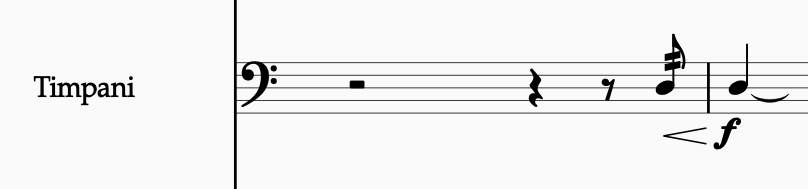
Leaving it open lets the musician shape it in context. And in real life, that works beautifully.
The NotePerformer Problem
In Michael’s video, he highlights the inevitable friction: notation software doesn’t think like a musician.
Specifically, NotePerformer reads the last explicit dynamic marking. So if you have two identical crescendi in a row, both ending in f, the second crescendo will start from f as well.
My Sibelius Workaround
Here’s the practical fix I use in Sibelius:
I place a hidden p at the start of the hairpin.
The visible notation still shows only the crescendo.
The playback engine now understands where to begin.
When I copy the figure, the hidden dynamic travels with it.

The musician sees elegance. The computer sees instructions. Everyone wins.
It’s one of those tiny engraving tricks that makes a mockup behave while keeping the score clean.
Repeated Crescendi: Less Is More
In another episode, Michael discusses repeated identical crescendi. His point: you don’t need to restate the dynamic marking every time.
Again—fully agreed.
If I draw a specific dynamic shape the first time, I’ll:
Write the full dynamic information.
On the second occurrence, use hidden dynamics.
Add a hairpin with the text sim.
From then on, just draw the hairpins with hidden dynamics.
Because repetition doesn’t require redundancy.

Too many dynamics clutter the page. Too much visible instruction can paradoxically reduce clarity. Musicians don’t need to be spoon-fed every bar—they need a clear pattern.
The Larger Principle
This is really about two overlapping systems:
The musical system (humans reading intention).
The playback system (software reading instructions).
If you serve only the playback system, your score becomes visually heavy and mistrustful. If you serve only the musical system, your mockups can become misleading. Professional notation sits between the two.
Rachmaninoff didn’t write for NotePerformer. We do.
But that doesn’t mean we have to sacrifice elegance. It just means we need a few invisible helpers behind the curtain.
Happy orchestrating.